Thursday, February 1, 2018

A Wine-Stained Book (Imbolc 2018)

A Wine-Stained Book (a reading)


In a conflict on which the sun never rises, battles are fought by starlight on moonless nights as unsuspecting citizens soundly sleep. Unaware or uncaring, they choose sides only slowly as each new situation pulls the heartstrings of alliances until doctrinal lines have been drawn. Unwavering, they pivot and maneuver with each faction seeking territorial advantage from the political terrain.

A proxy coalition faces off against an army of conscripted ideology whose unholy warriors see only life slaves in a kingdom of the dead. Memes and social media fan pre-existing passions and prejudices until embers glow along the edges of society. Each side undermines its own self-interest, performing opinion poll sortilege to the lowest common denominator through a series of false dilemmas and Hobson’s Choices. Eventually all but the most stolid have been assorted and arrayed toward contradictory poles that but a few years ago they would have refused to recognize.

Alienated by a common language, their right and left hands live in isolation wards where home- and hinterland are fundamental worlds away. To self-comfort, they recite internal fairy tales to relieve the anxieties and distress spun from the irreconcilable hypocrisies and inconsistencies of identity politics. Armed and armored with myths, misconceptions and misinformation, they craft an artificial irreality cast in the constant glare of a mirror chamber that transforms existential crisis into existential threat. In this political theater, the supporting actors forget they’re only lines, the audience never knows, and so the acrimony grows real. Ultra-nationalism, the aphrodisiac all rhetoricians use to seduce the young into battle.

A shadow war unfolds at the speed of plate tectonics, the boredom building day by day until one slip erupts into brief yet violent motion. As protestors and counter-protestors face off against clandestine provocateurs, a single misstep escalates into bloody conflict while police referee the sidelines. Miscalculation and misapprehension fan the open flames into full conflagration on its way to civil war. Carefully cultivated tensions spit and fume until prevailing winds shift carrying sparks that overrun the fire lines, fracturing the terrain. True and penumbral governments emerge and disappear as the fires and backfires they stoke rage beyond control. Most are bad at governing but good at coup d’etats.

To punish each collaborative province, they engage in slash-and-burn economics, exploiting every resource for prophet or personal gain. Divided yet unconquered, each faction carves out an armed, autonomous enclave. Militia compounds bloom like Balkanized alpine meadows or knots of prairie wildflowers, most brief but startling in their transformation of the landscape. Reconquista grinds down to the tactics of siege, blockade and interdiction with each leader skimming retributive tariffs for allowing anything resembling starvation level black market trade.

As geographic bachelors in desolate garrisons watch the enemy's wives and children eke out a meager subsistence, their thoughts drift home. Held hostage by boredom, apathy and ambivalence, they allow empathy to briefly overcome antipathy. In a moment’s inattention, lives end, lives begin, lives change forever as each side ruthlessly rewards only enmity and animosity in the geometry of exploitation and control.

Each clean, new widow, wiping away the dried rime of her tears, accepts her next role not as wife or mother but as a dark, avenging angel. Using the strategies of seduction, surrender and self-destruction, she exacts her revenge one unbeliever at a time, a soldier, a collaborator, a wayward child. Each victim with his own aspiring Valkyrie perched beyond his shoulder preparing to choose another sacrifice to the eternal flame.

And so we descended the spiral staircase, misstep by misstep, casualty by casualty, generation by bloody generation, until all that remained to mark our passage were the impressions transcribed into this collective record of a bygone age, carefully preserved as it passed from hand to unknown hand.

We are the inheritors of the accounts in this edition, a paragraph here, a sentence there, saddle-stitched together into something resembling an integrated whole. We, who emerged from this misty past, balance the ledger by keeping it current even as its ink fades like the dog-eared Polaroid of a distant memory.

Our words have enemies just as surely as enemies have words. We are all prophets in hindsight, our suffering inseparable from our destiny, our misery spiked with love. When no one else listens, we tell each other sweet lies in the dark as if living in a dream. But deep inside, we all remain the children of Cain. The pen may be mightier than the sword but its nib still needs to be cleared of blood.

The triumph over trauma and tragedy comes not in reliving them but in allowing them to settle into mindful forgetfulness. We all long for an ideal past misremembered, a misforged bell that we’ve forgotten cracked as we mishear its final note ringing in our ears. We are emotionally driven creatures who craft elaborate fables about being rational to lull ourselves to sleep at night. Sleep, the amnestic victory of children and the damned.

In these pages, the past shifts restlessly in its grave like a creature neither alive nor fully dead. We are the watchmen who do not sleep, the ones who feed its flame and tend its tomb so that future generations may remember.

As now are you who read this wine-stained book.


© 2018 Edward P. Morgan III

Thursday, December 21, 2017

Winter Solstice 2017 - The Toy


When I composed the list of potential poems to use as the subject of this year’s essays, I knew The Toy would be the last. It fit my sense of the season in some backhanded way.

So many people want this time of year to be their idealized version of what they think it should be. Something Norman Rockwell filled with happiness and light. For me, it never will be. I have too many memories. The scars, some specific to the holidays, cut too deep.

Here’s a secret many people recognize but fewer want to admit. For many people, this time of year is more painful than joyful. Too many old wounds that gathered family sometimes seems to delight in reopening without enough balm of love to make the pain tolerable.

That is why I adopted a particular piece of psychological advice a couple decades ago. Make the holidays your own. If certain things give you comfort, do them. If meeting a particular societal or familial expectation doesn’t then don’t. It really is that simple. But admittedly easier said than done.

We enacted that advice in celebrating the longest night of the year rather than Christmas. I’ve written about our candle vigil in other Winter Solstice messages. It took time and a long transition before we were brave enough to admit that we don’t celebrate Christmas, that there’s just too much overburden with that holiday for us.

We have tried to share our holiday with other people with limited success. Because we celebrate 3-4 days early, most people we know are still in a frenetic, pre-Christmas rush. They just don’t have time. Or choose not to make it.

Instead of giving each other a host of things we might not want, we limit ourselves to one (hopefully) meaningful gift for solstice and then choose a number of things we want to order to enjoy together or separately throughout the year, mostly books, music, movies, games, graphic novels, and lecture series. It is much less stressful for us which means we enjoy our time together more.

In the past several years, that advice has extended to Thanksgiving as well. In an ideal year, the week of Thanksgiving and the week between Christmas and New Year are the times we watch a movie marathon, set up some long games we normally don’t have time to play, read books and graphic novels on the porch while I can enjoy being outside, and listen to some music, classical or contemporary, that is piped throughout the house. We try to fix some foods we don’t eat normally, a duck, a lamb, a roast, mashed potatoes, spinach-cheese pasta, butternut squash. Plus we indulge in a few luxuries we don’t always have on hand, exotic coffee, imported tea, English muffins, cookies, spices, dark chocolate, maybe a moderately expensive wine, brandy or cognac. For me, a little black Cavendish pipe tobacco.

So what does any of that have to do with this poem?

Someone asked me a few weeks ago how I thought this year’s essays and poems were going. The response has been hit or miss. I think many people view this year’s offerings as my dwelling too much on the past. While I can understand that point of view, what I have tried to do this year is be honest about the way I feel, in the same way I was with a few essays that recounted incidents in my past a few years ago. I firmly believe that poetry more than any other writing demands that honesty.

But we as a society and as a species rarely reward such honesty.

I’ll give you another small piece of it now. This year the poems and related essays, which I knew would never be a favorite, were all I had to offer. I managed to complete one story before my world continued to unravel. An unraveling has gone on for just over two and a half years. An unraveling that has ground me down and at times seen me shut down every unessential activity to focus on pure survival.

Very few people know all the details of that unraveling. In fact very few people want to know. Many have made that painfully clear. A few have said it quite bluntly. Watching  people I thought were friends retreat when they began to learn exactly what was going on did nothing to improve how I felt about myself or about my situation, even though I knew from experience it was likely happen.

Ironically, a particular meme has made its way through social media all this year. Something to the effect, “I am posting this number to the suicide prevention hotline to let my friends know I am listening, and I challenge you to do the same.”

While that’s a great sentiment, let me respectfully point out what’s wrong with the execution. If you really care about a friend’s psychological wellbeing, the first thing you should say is, “Talk to me. I will always be here to listen.” Only after establishing that should you add, “And if you aren’t comfortable talking to me or another friend, here’s a number you can call to talk to people who can help.” And that you say offline.

Now unless you’ve ever spent several hours talking someone off the ledge, or been talked off the ledge yourself, you likely have no idea how important that initial statement is. It says you are not passing off their situation to someone else, thinking someone else will handle it. Thinking you really aren’t that close and don’t want to intrude or pry. Thinking there are professionals better equipped to deal with it. Thinking there is nothing you can do. Most of those are just excuses because you feel uncomfortable and don’t really want to get involved.

Adding that initial statement, and meaning it, says you really care. There are moments in this life when that tiny addition makes all the difference.

Which circles back to what I had hoped to generate from this poem and essay: empathy and understanding. Not so much for myself as for the people who remain silent, struggling with experiences and emotions they can’t always put into words but perhaps I can. Understanding that many, many people struggle this time of year, whether they choose to share that facet of their lives or not. The empathy of knowing that not all scars fully heal.

So how can you help those people you think might be struggling? With some, inviting them to be a part of your family celebration might be the right idea. While others might find the situation exceedingly awkward for reasons that have little to do with you or your family. Not everyone is looking to be included in someone else’s family. Many cannot help but be reminded that your family is yours, not theirs. Most just want to be remembered as a friend.

You can rarely go wrong by making a little one-on-one time for that person. A lunch, a dinner, a coffee, a dessert, a drink, a movie, a game, a concert, a lecture, a walk, a quiet conversation. Some small amount of time to show them that you care. Time that says, I was thinking about you. I value you. Thanks for being around. Just time. That is often the greatest gift of all. Not only in this season but all year long.

In the end, no matter how you celebrate the season or which day of the season you celebrate, that is what it is supposed to be about.

And no matter who you choose to mark it with, may your solstice once again be warm and bright. 


 © 2017 Edward P. Morgan III

Tuesday, October 31, 2017

Samhain 2017 - Generations


At Samhain, we play with death, exploring the barrier that separates it from life, trying to lessen its scariness in a way. Or reinforce its mystery. Like many events in this life, death either brings out the best or the worst in us. Or in the shades of grey world I live in, perhaps a bit of both.

I remember exactly when I wrote Generations, about a month after my grandfather died. Of all my grandparents, his death was the hardest to deal with for numerous reasons. I was back at home after what at best would be called a stressful experience. Not just his death but the way my immediate family handled it.

As children, as young adults, most of us learn how to handle death by watching our parents deal with it as their parents or, increasingly, grandparents die. Or how they don’t. Most of these lessons we absorb without knowing, without thinking. But they influence our behavior nonetheless, just as ours influences the generation that follows after. These are very difficult cycles to break.

Fortunately, many of us have more than a single pair of role-models to draw upon. It’s not to say we will pick and choose how we will react. I think too much of that is either learned too early or hardwired in. More that we will absorb and synthesize many different reactions from parents, grandparents, aunts, uncles, siblings, cousins, family friends, complete strangers. Who shows up, who doesn’t, who has to be coerced. Who takes charge, who falls apart, who leans on who for support. Who looks out for who with small kindnesses and who takes the opportunity to air old grievances.

I remember my first experience with death, the first time I watched the last of a generation die. I think I was in first grade. My great grandmother, who I want to say was over ninety and in a nursing home at the time, died. As with her life, I don’t remember many details of her death. Before she died, I remember visiting her on one of our trips to Boston in a very alien and scary (to me) nursing home. I remember she didn’t recognize many of us. I want to say my sister and I waited outside her room because we were pretty much unknown entities to her by then. I seem to remember my mother got the call that she had died at night. I remember crying because she was crying. I remember I didn’t sleep well that night. I remember still being sad in the morning, though I wasn’t sure exactly why.

The thing I remember most was the reaction of a teacher. When I showed up at school the next day, I think I cried again. My teacher came over and asked me why. I told her my great grandmother had died. In an admonishing tone that said I needed to stop, she said, “You are lucky to have had a great grandmother. Most of these kids don’t have grandparents.”

I was twenty-eight when the first of my grandparents died. My paternal grandfather. By the time I was forty-one the last of that generation of immediate family was gone, my paternal grandmother. With each of the four of them, I was fortunate in knowing the last time I saw them would likely be the very last, so I purposefully set those scenes into memory. In each case, I remember very specifically absorbing every detail I could. I’m not sure why or where I got it. But they are the memories I cling to.

With my father’s father it’s a memory of him brushing his hair to ensure it looked right before he moved out to the living room and settled in his favorite chair for my final visit, like everything was normal. With both my mother’s parents, it’s seeing them standing by their apartment door as Karen and I turned back before boarding the elevator down the hall, the first time with both of them, the second him alone. With my father’s mother, it’s a final lunch out by the water before she moved to a facility fifteen hundred miles north.

Then there was my father, the first of the next generation of immediate family to fall away. My father is the only person I’ve witnessed die. Counting the seconds between his final breaths is emblazoned in my memory.

I had considered writing about each of their deaths and how my family reacted to them. In fact I had it written up. But after allowing that draft to settle, I decided it wasn’t what I wanted to say. What we said and did would likely be as meaningless to anyone else as any of those memories.

Suffice it to say there were phone calls, there were tears, there was drama. There were connections formed and connections lost. There were four memorial services, two with huge reunions of friends and family, two for immediate family only. There were three stealth burials, two in suits and ties with spades and shovels and other implements of destruction complete with skirts and dresses serving as lookouts, one conducted under cover of darkness by just me and my wife. There were bitter feelings over property, there was easy sharing and compromise, there were long battles fought to ensure final wishes were met. There was protocol, there was censorship, there were recriminations. There was a suicide, a secret deal, a murderous accusation, and a synchronicitous inheritance.

So pretty much like any holiday dinner with family.

But in too many cases, recounting those events opened too many old wounds. Neither you nor I are interested in my tears of blood.

I’m not sure what I take away from those experiences. All of them were difficult, some more so than others, perhaps because of the event itself, perhaps because of the people and the circumstances involved. There are moments I cherish in each and moments I despise. I suppose there’s no escaping that in this life. But I think I am getting worse at this as time goes on.

I read a research brief this week that said even after your heart stops, your brain still forms thoughts. Which means it’s very possible in that sudden stillness you know you’re dead at least for a few seconds. Which probably bothers me a lot less than it does some of you.

So as I watch the generations change over season by seasons, at least one day I know I will find my peace. 


© 2017 Edward P. Morgan III

Friday, September 22, 2017

Fall Equinox 2017 – Two More Short Poems


When I picked these two poems to post on the fall equinox earlier in the year, I didn’t realize how appropriate the timing might be. Both relate to balance, the patterns of light and darkness that illuminate and shade my mind.

It has been a strange few weeks. First we had company for an annual long weekend gathering to celebrate our geekdom. Then without a pause, we began preparing for Hurricane Irma. Last week, we cleaned up the aftermath. This week, we kept one eye on Maria, hoping we didn’t have to prepare again, as we tried to remember where we were and get back to our routine.

We were fortunate and took no damage from the storm. But we didn’t know that when the forecast track a day before landfall centered what would have been a major or even catastrophic hurricane literally right over our house.

The Saturday morning before the storm, I felt like a Viking ready to burn his boat on a foreign shore and cast his fate to the Norns. “I am Edward son of Edward. Destiny is all.” We had done what we could do and were down to helping others. By Saturday evening, we were buttoned up tight behind plywood backed by hurricane-rated windows, to the point we couldn’t see almost anything outside.

We had prepared in ways we never had before (in a lifetime of living in Florida), even during our record 2004 season. Things like photographing and bagging paper copies of every account and important document we had so we could reconstruct our lives, having the cat carriers, collars and vaccination records in the laundry room (our safe room), having Karen choose the jewelry she absolutely couldn’t live without, and creating and waterproofing a bug out bag with what few items we couldn’t stand to lose. Yeah, we were that spooked by this storm.

I’ve listened to a number of people discuss what they grabbed to either evacuate or to put in waterproof bags on high shelves in case of the worst. These are personal choices that no one can really argue with. Choices that show what each individual values. For some, it was family photos or videos. For others, irreplaceable heirlooms or jewelry. For a few, it was mementos, music or books. For still more, it was more practical items like clothing, tools or food. Most included copies of important documents. All that had them included their pets.

My personal go bag only contained a triple backup of all my writing and blog photos (a hard drive and two memory sticks) plus a favorite leather notebook. After the fact, I thought I should have added the small, handwritten book of my poetry. Though in reality, the words themselves are more important to me than the packaging. The only other thing I might have grabbed was my pipe. But that I could (and probably should) live without.

So if I had to walk away, everything that I deeply cared about would fit into a satchel smaller than most women’s purses. No photographs, no mementos, no books, no games, no jewelry. Everything physical can be replaced. It’s all just stuff to me. Have cash will travel. And rebuild.

My writing is my identity. I have lost words before. Twice I’ve been hit by computer crashes, one that took out the backup at the same time as the primary. Both times I salvaged everything with some help. Only once have I lost a piece that I was unable to recover, that from my own carelessness in not saving off an email about my perspective on a water drop falling in the shower. That one still haunts me. While I know the general outline, I also know I can probably never recreate it to my satisfaction.

As I said at the beginning, both these are somewhat timely poems about the way I think about writing, as well as about distractions and fragility. They both continue to give me perspective.

Through My Eyes I started in 1990. I don’t remember the specifics of when it came to me that year. All I found is that it starts on the fifth page of my oldest notebook and then gets edited maybe a dozen pages further in. I may have worked on it some during our at-sea demo that year. Or it may have come to me as I started detoxing from a long year of deadlines and overtime.

But I can still hear that opening line in my head in my own voice. It rings like a mantra and is still true to this day. It very much captures the way I end up working, waiting for the fog to lift to where I can get the ideas down. Writing is not always a natural process with me. Stress, distractions, headaches, some amount of any of them can enhance my creativity. But too much ends up shutting me down entirely. Once that happens, it can take a long time before my mind convinces itself that it’s safe to focus on something other than survival.

I very much remember writing Before Surgery. This started as a line that when I wrote it down I didn’t think it was a poem. I only decided it was when I stumbled across it sometime later.

I wrote it the day before I had gallbladder surgery. Once again, I had been under a lot of stress in the previous year. Exactly a year before, I had transitioned from engineering to writing and was still trying to ensure my budget calculations were right. As well, the previous August, I had come down with shingles which wiped me out until nearly December. Just after I recovered from that, I caught a spider bite on vacation that saw me sleep for twenty-three hours straight. Then I went to the ER from what I (and the doctors) thought where back spasms that really turned out to be from gallstones.

Somewhere in there, I started counting the number of times I’d been under anesthesia in my life. I got nervous, I’m not sure exactly why. Probably from too much familiarity with bell curves and random chance from gaming. But I remember sitting in the office the afternoon before (which was still the library then) and reading Carolyn Forche’s Against Forgetting: Twentieth-Century Poetry of Witness, a book of poems she gathered and edited from “significant poets who endured conditions of historical and social extremity”. In other words, authors who witnessed the grimmest wars, genocides and social repressions the century had to offer.

Many of those authors did not survive the events they recorded, some in heartbreaking fashions. One I specifically remember involved a political prisoner from Hungary in WWII who was sent to a forced labor camp in Yugoslavia. He wrote in a small notebook as he was force marched back to Hungary just in front of the advancing Red Army. He died weeks before he would have been liberated. He and a score of other survivors were shot when they arrived back home because there was no room in the local hospital for them.

Reading it reminded me how fragile our lives can be. That often that fragility comes from events beyond our control. And that during such events, as writers we need to take charge of the elements of our lives that we can control in order to make sure our voices are heard. Many of the pieces I read that day were both powerful and haunting. As a young writer, it made me wonder what I might have had to say.

Older now, this one continues to resonate as well. Some days I still wonder when the ideas dancing through my mind outstrip my ability to bring them to completion. At least now I feel I have something to leave behind even if I don’t feel that body of work is yet complete. I may never feel it is. At that same time, I try to allow that thought to motivate me. Time moves forward. And while time itself may be eternal and enduring, our time on this earth is not.

As we were reminded at the height of the storm when Karen received a text from a friend. Fifteen minutes earlier, her friend had given up and gone to bed, thinking the worst of the storm was past. Her husband remained awake in their living room on the couch. A huge tree came crashing down, crushing their garage and landing across their neighbor’s roof right in the part of the house where people would be sleeping. Her husband rushed out into the teeth of the storm to make sure everyone next door was ok. They were, but it left a bit of a psychological mark all around. If that tree had fallen just a few feet to the left, it might have been him as well as the garage that was crushed. Life can change in an instant.

Which is why, when we are able, we have to do the things we love as best we can. When we can’t, we must cling to the hope that one day we will again. And as we reflect on both these times, we must remember the balance of the equinox, that just as light creates the shadow, sometimes shadow defines the light. 


© 2017 Edward P. Morgan III

Tuesday, August 1, 2017

Lughnasa 2017 – Two Short Poems


Over the years, people have told me that they see me a particular, often consistent way. They use words like driven, organized, persistent, intense. I’ve heard I’m intimidating. That I have eyes that look right through you. I’ve been told people envy my life, my opportunities. Some of them have been downright jealous, not in a positive way. Some frustrated that I don’t seem to recognize what I have. But most seem to agree that it looks like I know what I want, what I’m doing, and where I’m going.

News flash: Appearances can be deceiving. Objects may be closer than they look. All of us feel like frauds. Some of us just acknowledge the reflection more quickly than others.

As I remember, Life’s Path came to me pretty much in one sitting. It reflects how I felt about my life at the time. How I feel again. How I think many people feel off and on. Some all the time.  

I don’t specifically remember what I was thinking as I wrote this. I can piece together the events that led up to it and events that happened after. This fell in a lull in what I think of as monumental events. Life-defining at any rate. So a quiet moment. An interstice.

For two years, I’d been struggling to come to terms with someone else’s recently revealed secret and other people’s reactions to it. The landscape behind was pockmarked with the scars of battle, now faded but easily recognized as having reshaped the terrain even if incompletely grassed over. Two years later, I had embarked on a completely new path into the unknown, one I was warned by multiple people on multiple occasions was a mistake, as were my preparations along the way. I think they saw the outcome as something quite Grimm.

And yet, here I am. Still stumbling forward. Still laying my own path. Still lost.

When you get lost, the experts advise that the best thing you can do is stop moving. You are likely to make your situation worse. Sit and wait for someone to notice you are missing, to mount a search and come find you.

But what happens if no one’s looking?

Your next best bet is to inventory your situation and pick a direction you think will lead you someplace you want to go. Of course, most people strike out to intersect a major road that leads back to civilization, not delve deeper into the wilderness.

Either way, the experts will also tell you that personal psychology plays an important role in survival. Staying positive about your situation is critical. Even if it means fooling yourself by following a trail of breadcrumbs you throw out before you. Eventually, you will get somewhere.

I am still hoping wherever I end up in the dark forest of this life isn’t made out of gingerbread. Though sometimes I do very much feel as though my metaphorical home in this society never had enough provisions for someone like me, which is why I set out. I try to remember that’s why I wake up each morning, though some mornings that is more difficult than others.

Recently, I read an article which said newer poets tend to confuse obscurity with meaning. I think Morning Ritual might fall into that category. I’ve had people who have read it say they weren’t sure what it was about. Which I can totally understand. (It’s about coffee, by the way, if the picture didn’t give that away).

This is another piece that came to me in a single sitting. Once again, I can’t tell you exactly what was going on at the time. Though I have the distinct impression that I was tired and headachy which often inspires creativity in that detached, lightly tethered kind of way. Perhaps I wasn’t fully caffeinated. I don’t know how many people I’ve met who are completely transparent before they are fully awake and have a chance to don their daily mask. Only after that first cup of coffee do they appear to be solid again.

I didn’t start drinking coffee regularly until I was twenty-eight. I started because I was getting migraines and had read research that indicated a cup or two of coffee each day might help mitigate them. Since then, the number of migraines I get has gone down but not disappeared. Oddly, when one is just beginning, or doesn’t quite take hold, I get some of my most colorful bursts of creativity. Though working through them can be quite a trick. It takes more discipline than people realize to write down those odd thoughts, observations and lines through the fog and pain. But more about that at the equinox maybe.

This one perhaps best represents how my mind naturally works in those unguarded moments, with layers of allusion and symbolism sometimes densely packed. It reminds me of some of the better daily lines I posted several years later, many of which have served as the foundation for other poems, or sometimes more poetic essays.

It’s strange to me how some of what I call poetry starts out as just simple statements of how I feel that then get cut up and rearranged into something someone else might recognize as a poem. When I first write out many of the lines in a notebook, I often think they are the opening lines of an essay. Sometimes it takes running across them years later to recognize they were actually complete thoughts on their own all alone. That all they need is light editing and structuring.

Sometimes I think the old vocabulary words that surface at these times, along with the snippets of mythology, archetypes and odd perspective, are like the floaters you see swimming before your eyes. Detached bits of subconscious code that echo in memory until they briefly interact as a valid instruction set. When they go noted, they often are soon forgotten. Or maybe they just submerge until they encounter another upwelling from the deep. Or become diffuse as they’re reabsorbed and reintegrated.

Or perhaps they are just the trail of breadcrumbs my subconscious throws out before me in this dark wood so I don’t lose my way again. 


© 2017 Edward P. Morgan III

Wednesday, June 21, 2017

Summer Solstice 2017 - Sunday Servitude


(This is an essay related to the poem Sunday Servitude posted on the fiction side of this blog).


I started writing Sunday Servitude back in 1990, in the spring. I remember exactly where the first line came to me. It was a pleasant spring day. I was reading and drowsing in the sun by the pool of my apartment complex. It was mid-morning on a workday with no one else around.

The life of Riley, right? That’s what most people assume I live like even today. Doesn’t every writer? Especially poets, who are a sketchy lot to begin with?

Well, not quite, at least then. At the time I was working 60+ hours a week in systems integration. Ten hour days in the lab, six days a week, minimum. This was back when I was still in engineering. At the time, I was working either second or third shift and had been for six weeks straight. Not by choice. Because I was single.

So that day I was desperately trying to recharge with a little down time before I went into work, and succeeding. Right up to the moment the landscaping crew showed up for their weekly maintenance. I was quite annoyed at the time, in that frustrated way you only can be with situations over which you know you have no control. A perfect moment ruined by the noise. Not enough time to wait it out and get back my Zen.

As they were finishing up, that first line popped into my head. Like the calls of birds marking out their territory by song. I wrote it down. A few others followed over time.

More came to me after we’d rented a house a year later. Most after we’d bought our first house a year after that. This was back when I was still able to do yard work without my grass allergies trying to kill me.

Growing up, my mother put me on lawn mower duty at 13. At the time, I wasn’t really big enough or strong enough to get the pull-rope on our old mower to spark it to life. I remember many a summer afternoon in the driveway struggling with it to near tears. Not that my mother much cared. The lawn needed to be mowed. She wasn’t about to do it. My father had been gone for three years. I was male, so it fell to me.

I was never so grateful as the day a neighbor across the street took pity on me after watching me for a while. He wandered over and taught me a few tricks. Things no one had ever told me. Like checking the sparkplug to make sure it wasn’t fouled, cleaning the air filter was gas (who knew there was an air filter), checking and filling the oil. Removing the carburetor and slipping in a little gas to prime the engine. Where to place my foot for leverage. How to snap-pull the rope. My mother assumed, again because I was male, that somehow all this knowledge was either inherent or genetic. Rest assured it wasn’t.

It’s probably no wonder I hated yard work. That hasn’t changed. But it still took until Karen broke her back just before I left engineering for us to get a lawn service. Our last mower (which was much easier to start) strained her back too much after that. Like most chores, we split yard work. By then, my allergies had gotten worse. While Karen doesn’t have my aversion to it, it wasn’t her favorite weekly activity. And we have never looked back. Now anything we do in the yard is because we want to, not because we have to.

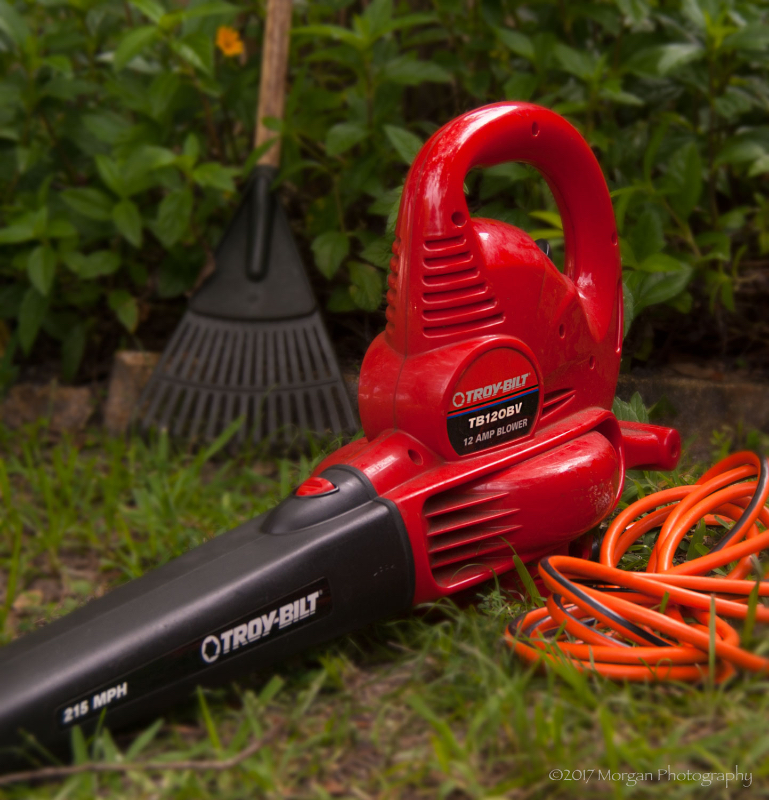
A number of houses in the neighborhood have lawn services now. Of course, all on different days. One across the street is Tuesday, ours is Wednesday, another’s is Thursday. I think the thing I dislike most about lawn maintenance is the noise. I’m an auditory person. Noise like that disrupts me. At least the professionals tend to be efficient which minimizes it.

Even today, I think that leaf blowers should require an operator’s license. I don’t know how many times I’ve watched (and listened) to a neighbor blowing for forty-five minutes to get the very last stuck oak leaf off their driveway (not an exaggeration). A job that with a push broom would take fifteen at most. Or started mowing at 7 a.m. on a weekday or Sunday. The same neighbor who, whenever he saw us in the yard, would drawl, “I love to see people working.”

Yeah, I am not and never will be one of those individuals who relaxes by pushing a mower, or gets satisfaction out of the clean line of a weedwacker or an edger. I don’t get excited by about the machinery, which is just a tool to me. No different than a word processor, a necessity for the job. While I love the look of a well manicured lawn, I’m just not the individual best suited to attain it. I’d much rather read by the pool and dose.

I suspect as summer swings into full force with its blazing heat and humidity, at least down here, that I’m not the only one.


© 2017 Edward P. Morgan III

Monday, May 1, 2017

Beltane 2017 - Felicia

(This is an essay related to the poem Felicia posted on the fiction side of this blog).


Spring is a hard season for us and cats. Thomas, Sandy, Smoke, Sara and Felicia all died between the spring equinox and the summer solstice. Three we knew were coming for a long time, two we didn’t.

A number of people might not understand this poem or why I’m posting it. They may feel it’s frivolous, or trivializes what they see as more important deaths. People’s deaths. Human deaths. With death as with life, it’s all in how loss affects the living. Just as with who we love, we rarely get a choice in who we miss.

1996 was a hard year. One of the hardest of my life. It came after the year Karen had sworn me to silence about what her brother had done to her. It started with that silence being lifted, with her telling her parents, with her confronting him. None of that went particularly well. Worse now.

That year of silence had taken its toll. It’s not in my nature to sit quietly rather than to confront injustice. That enforced silence ate at me. It ate at our relationship. It ate at my attitude at work. It ate at my friendships, at people who I’m not sure really understood or could deal with me dealing with it. That issue was ravenous, insatiable. A beast that consumed way too much of our time, energy and attention.

In February, we noticed that Felicia was getting sick. A lot. Almost every day. Because of everything else going on, it took us longer to notice than it should have. We took her in to the vet, got recommended to a specialist, got her examined, got her tests. The results came back. Cancer. All through her abdomen. She was nine and a half years old. Not old for a cat but not young either.

My focus immediately shifted to her. We briefly tried a treatment of oral chemotherapy with her but quickly abandoned it when it was clear she wouldn’t tolerate it. After that, all we could do was give her medication to make her comfortable, try to get her to keep eating and wait.

Felicia is the only cat we’ve had who literally knocked at our front door. Ok, she didn’t knock. She cried.

I was living with Karen at the time. I’d graduated college six months earlier. Five months after that, I’d moved in with her once it became clear I could no longer live at home. Not that I every really could.

Karen had a cat named Duncan who she had gotten from a nearby pet store. He was a product of that environment, what we’d call today under-socialized when he was a kitten. He was probably taken away from his mother too young. He was friendly enough until he wasn’t. He’d turn aggressive on a dime. Karen had become a dead-eye shot with a water sprayer just to keep him from running completely wild.

I’d never lived with a cat before. My mother was allergic. She’s more of a dog person anyway. But Duncan had me thinking that living with a cat might be ok. He started me thinking about the personality traits I would want in a cat. Over that first month, I constructed the ideal cat in my mind. The only thing I hadn’t thought about was a color.

Karen and I were sitting at home one evening in December when we heard a crying out front. High, tiny, plaintive mews as if someone asking to come in. When we opened the door, a kitten was sitting on the doorstep looking up at us.

We petted her and looked her over. She was amenable to being handled so she’d been around people. We quickly spotted that all four of her paw pads were burned, blackened, cracked and bleeding. She had a cut and a kink at the tip of her tail like it had been broken. She had a nasty bite wound on her belly.

We brought her inside, not knowing what else to do. She curled up with us on the couch and started purring. And she didn’t stop purring for thirty-six hours straight. Thus her name, Felicia. Happiness.

I remember asking Karen like a kid if we could keep her. Like an indulgent, yet responsible adult, she said we should post a notice. I said no way, if someone had owned this kitten before, they’d lost their rights by the condition she was in. So we compromised. Karen would ask the apartment manager if anyone had reported a lost kitten. No one had.

We had the vet examine her. She was maybe three months old. He thought a tomcat had given her the wounds on her belly and tail. The only hopeful explanation any of us had for her paws was a road repaving project over a mile away. We didn’t want to think about the alternative. He gave us antibiotics and a sulfa lotion for her infections. He started her with her first round of shots. We picked up a flea collar.

Initially, Duncan wasn’t sure what to make of her. But then he decided she was a perfect playmate. She wasn’t as sure about this. But she proved to be quite the tactical kitten, figuring out all the tiny spaces in the apartment where she fit and he couldn’t. Especially places she could dart into, turn around and swat his nose when he stuck it in. For a little kitten, she more than held her own.

As it turned out, every trait I’d thought of in my ideal cat Felicia had. Patient, curious, affectionate, accepting. As I said, the only thing I hadn’t considered was a color. She was a tortoiseshell calico, so in that I had my pick. I came to think of her as my familiar.

Felicia was definitely more my cat than Karen’s. I was the one she clung to. Probably because right after we took her in, Karen went home to East Longmeadow for ten days for Christmas. So I was the one Felicia imprinted on. The giver of food, the cleaner of the box. The warmth she curled up with at night when I shut Duncan out of the bedroom to keep her safe.

A month later, she and Duncan moved with us to a new apartment in Melbourne. Not six months after that, we all moved again to DC. She and Duncan rode with me as I drove Karen’s little car while she drove the truck, which was quite an adventure in late May with no AC. Felicia spent most of the trip curled up behind my neck, or at my feet, trying not to get tangled in the pedals of the manual transmission.

When Duncan died quite suddenly that first summer, we adopted Sandy, who had been abandoned with our vet. Felicia saw her long as a lost sibling. She never had a problem with any other cat we adopted. Thomas, Smoke, Jasmine, she got along with each and every one, even if they didn’t always get along with each other.

She moved with us from Silver Spring to Gaithersburg, from Gaithersburg to Largo, from Largo to Pinellas Park, from Pinellas Park to Seminole. She became our most well-traveled cat, though she never really liked it.

As I said, she was my familiar. My comfort. My confidante. My little girl. I was fiercely protective of her because of how she came to us. She became the inspiration for a main character in my novel as well as a character in a game.

She saw me through stressful times. The months I spent desperately searching for my first professional job. The year Karen and I lived apart. The two years I spent working overtime while being denigrated by my coworkers. The second near split between Karen and me after we’d bought the house. Our getting married. The first and second periods where I traveled for weeks at a time for work and went to sea. I could never wait to see her when I got home.

And she me. She greeted me at the door whether I was coming home from work or returning from the field. She was always happy to see me. She jumped up on the bed each night to say goodnight. If she wasn’t sleeping by my feet, she’d come back when I got up to say good morning. She’d curl up beside me on the couch. The only time she’d sit on me was if I put a blanket over my legs in the recliner. She followed me around the house for weeks after I came home from a month in the shipyard and at sea, never letting me out of her sight, as if she wanted to be sure I wouldn’t disappear again.

I cared for her so much and so deeply, it made Karen more than a little jealous. What I’m not sure she understood at the time was that because of my background and the way I grew up, this little calico was teaching me how to love. Teaching me that it was ok to be vulnerable. Ok to show affection.

If Karen and I started fighting, Felicia would jump up on the table between us and look at each of us, as if telling us to cut it out. The adult in the room.

She was with me when Karen told me what her brother had done to her. She stuck with me during my vow of silence. As I was sorting all that out, I needed her so much.

I just didn’t see that she needed me, too. I still feel a crushing guilt that I didn’t see what was going on with her sooner. It was my responsibility to take care of her, just as she had taken care of me.

I would have sacrificed anything to save her. I understood that this was always part of the bargain between man and domesticated feline. We live longer. They almost always die first. But I wasn’t ready. I’d never be ready. I don’t think I am today. 

When we knew the end was near, we took some vacation so we could spend her last days with her. Karen spent the day before she died drawing her on the porch, which is where the above picture comes from. Felicia was restless. She couldn’t get comfortable. She hurt inside.

We fed her catnip and tuna juice, her favorite food, what little she would eat. We took her into the backyard on a leash which she used to love. A heron landed in the yard nearby. Even that close to the end, she wanted to take down that bird even though it was three times as big as she was.

We’d talked to our vet who agreed to come out to the house to put her to sleep so we wouldn’t have to take her in. After several visits to the vet and the emergency clinic, she hated car rides. We didn’t want to do that to her on her last day.

As we counted down the hours, we petted her, and purred with her, and lay with her on the floor. I held her on the porch when the vet arrived.

Felicia’s was the first grave I dug in our backyard. Five feet deep, through layer after layer of colored sand. We buried her with her favorite toys and blanket. We planted a yesterday, today and tomorrow over her. I caught my wedding ring on the posthole diggers which then tried to rip my finger off. That put a notch in my ring that remains there to this day. Something I will always remember her by.

I watched my father die and never shed a tear. With my little girl, I cried for days. I’m crying still. 


© 2017 Edward P. Morgan III